Showing posts with label Food Policy. Show all posts

Tuesday, February 5, 2013

The Other Inconvenient Truth

Ah man. From now on, anytime anybody asks why I am studying what I am studying, I'll just refer them to Jonathan Foley, who gave a riveting TED talk in 2010 about what he calls "The Other Inconvenient Truth".


Some of his major arguments why agriculture is one of the main challenges of the future: 
  • Already today, 40% of the Earth's surface area is devoted to agriculture. 
  • Of this amount, 16 Mio. square km are used for crops - about the size of South America. 
  • Also, 30 Mio. square km are used for livestock pasture - around the size of Africa. 
  • We are already using 50% of all fresh water reserves - and 70% of that is used for agriculture. 
  • Agriculture is also responsible for 30% of greenhouse gas emissions, the greatest overall contributor of all industries. 
  • We need to double agricultural production in the next 40 years to keep up with current consumption levels and population growth - but how are we going to do that without destroying vital ecosystems and depleting top soil, water and nutrient reserves that future generations depend on? 
Riley calls for a new form of agriculture, what he calls "Terraculture" - agriculture for the entire Earth, which combines expertise and knowledge of conventional farmers, environmentalists, organic farmers, animal welfare experts and the like to find ways for a new way forward in collaboration. For more on Riley's views on the perceived efficiency of particularly American agriculture, check out this blog post on Chewswise. 

Monday, February 4, 2013

Seed Banks– Deposits for our Future

No, seeds banks are not mainly located in Switzerland, and they were also not involved in the recent financial crisis. Instead, they are an insurance against the loss of agricultural biodiversity – a vital step when we consider the developments in the industrialization of agriculture in the last 100 years. The FAO estimates that 75% of crop biodiversity was lost between 1900 and 2000 – through globalization, the scaling up of retail and specialization in consumer preferences, the introduction and widespread adoption of new varieties that edged out local crops, and other factors. In addition, climatic changes could lead to a loss of up to 22% of the wild varieties of important staple crops such as peanuts, potatoes and beans until 2055. While precise figures are impossible to collect, it is estimated that there were as many as 100,000 varieties of rice a century ago in India, whereas now there only exist a few thousand; in the US, apple varieties decreased from around 5,000 to a couple of hundred.

Why is crop biodiversity important? Well, with each variety, you lose genetic material that has been adapted to the particular local circumstances, and could be vital in the future to adapt crops to more resistance to heat, drought, salinity, pest and diseases – on the flipside, if only one particular variety is planted over an extended region, a single pest or disease can have enormous consequences on the yield and lead to shortages and, in the worst case, famine.

This is why since the 1970s there has been a race to document and preserve crop varieties while they are still used, in particular through the establishment of seed banks. According to the FAO, in 2010 there were 1,750 seed banks worldwide, and around 130 of them hold more than 10,000 accessions. The crown jewel, of course, is the Svalbard Global Seed Vault, which was opened in Norway in 2008.

The Vault is located on a Norwegian island near the town of Longyearbyen, one of the most northern habitats in the world. It is constantly maintained at a temperature of –18 degrees Celsius, and due to its location – 160 metres into the permafrost – would probably take two centuries to warm to freezing point in a case of power outage. Plus, its tunnel head has a concave design in order to deflect a missile  strike. It’s supposed to act as a global backup for national and local seed banks, and with good reason – the seed banks of the Philippines, Iraq and Afghanistan have already been destroyed through accidents and/or conflict. The Economist has a fascinating piece on Svalbard if you are interested in more details.

However, part of the preservation of crop diversity is also its constant use and development, for which local initiatives are just as important – as for example the seed library in Basalt, Western Colorado, where a local public library distributes not only books, CDs and DVDs, but also packets of seeds which you return at the end of the harvesting season with the seeds of your own biggest and best fruits and vegetables. According to the American Library Association, there are around a dozen such programs in the US, and they have also spread to the United Kingdom.

File:Openforbusiness.jpg

Still, the maintenance of our crop diversity will remain a struggle, which in my opinion can only be addressed through the collaboration of individuals, governments and the global community and through the diversification of our food production systems.

For more information, the FAO launched a report on the State of the World’s Plant Genetic Resources for Food and Agriculture in 2010 – here is the executive summary.

Sunday, February 3, 2013

Let's Talk About Bees


Until recently, when I thought about bees, I would think honey. Or spring meadows. Or I would't think about bees at all. However, this changed when I watched the excellent documentary "More Than Honey" by Markus Imhoof, a Swiss movie director. The movie in equal parts explains the fascinating  social interactions in a beehive, stresses how vital they are to our food system as pollinators, and shows how our relationship to bees has changed. It was truly eyeopening to realize that in industrial fruit, nut and vegetable production (here is a list of all the crops bees pollinate), you also need an industrial scale of beekeeping - or at least, people think it's necessary. It's a part of the food production process you forget only too easily. "More Than Honey" also investigates some of the causes of the recent mysterious deaths of entire bee colonies - which seem to be linked to habitat destruction, the intense stress of being treated as yet another agricultural input with no regard to their social organization, and the widespread use of pesticides such as neonicotinoids. And it gives an ominous look into a possible future without bees in China and answers the question - who would pollinate our food crops otherwise? The movie is extremely well executed, with beautiful images, harrowing comparisons (think Swiss mountain beekeeper and Californian commercial bee-sinessman) and very limited subjective narration - it lets the people and images speak for themselves, which I liked a lot. Watch the trailer below or check out the movie's website for a preview!


Germany and France already banned some pesticides in the neonicotinoid family and recently, the EU Commission decided to recommend banning three poisons as well after more than 2 million people signed a petition in under 36 hours to take action. However, the final vote is still upcoming. 

For more information about the fascinating anatomy and life of bees, Stuff You Should Know just did a podcast on them based on this article

Saturday, February 2, 2013

2012 - A Year of Food Crisis Solutions?

In their article "Resolving the food crisis: The need for decisive action", published on 30. January on Al Jazeera, Sophia Murphy (from the Institute for Agricultural and Trade Policy) and Timothy A. Wise (the Policy Research Director of Tuft University's Global Development and Environment Institute) evaluate what global leaders have done in 2012 to address the food crisis. Their verdict: too little. Having published a report in 2011 on the main issues to tackle, they go through them point by point and investigate what change has been achieved this year. A round-up: 
  • Donor funding for agricultural development: Instead of renewing the L'Aquila commitments of 2012 to invest more public funding in agricultural research, governments have chosen to pursue public-private partnerships (through the G8's 'New Alliance for Food Security and Nutrition') that, in the words of Murphy and Wise, "revert[...] to donor-imposed conditionalities that give foreign firms greater access to Africa's markets." 
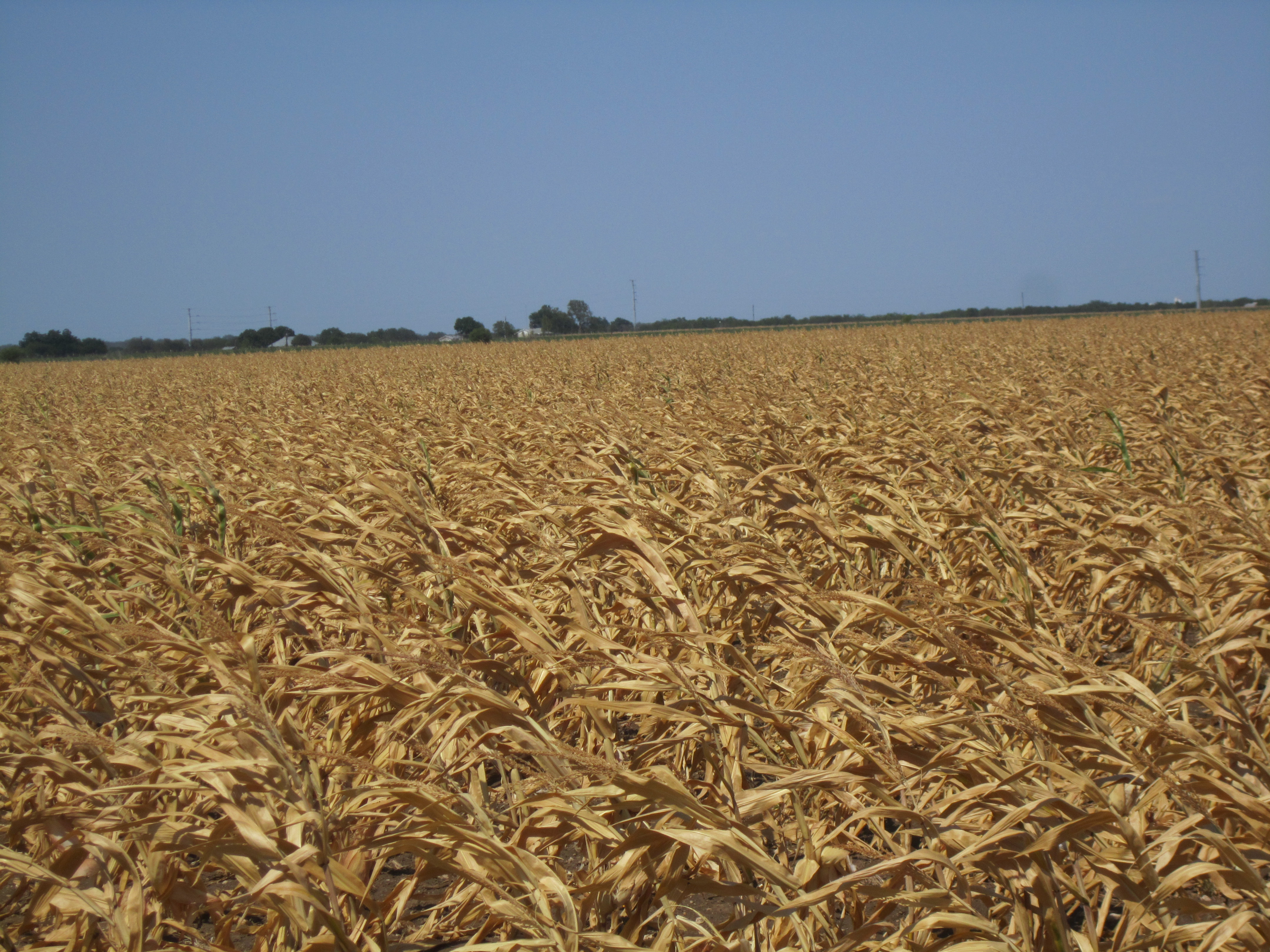
  • Reducing biofuels expansion: While both the US and the EU made progress in revising their policy targets regarding renewable fuels, the US's Renewable Fuel Standard remained in place and contributed to continued competition between food and fuel use of corn in the wake of the 2012 drought in the Midwest. 
File:Scorched corn fields, Castroville, TX, 2011 IMG 3231.JPG
Similar to these scorched corn fields in Texas in 2011, US farmers in the Midwest 
faced  huge challenges this year.  
Image By Billy Hathorn (Own work) [CC-BY-3.0 
(http://creativecommons.org/licenses/by/3.0)], via Wikimedia Commons
  • Curbing financial speculation on agricultural commodities: Regulations were initiated on both sides of the Atlantic, but lobbying efforts lead to delays that push implementation back to at least June 2013 (US) and 2015 (EU) respectively. 
  • Building food reserves: Publicly held food stocks "remain at historically low levels", according to Murphy and Wise, which makes prices more dependent on the immediately preceding harvest season and more volatile overall. Improved information systems among the G-20 are helpful to prevent panic buying (such as was discussed in the NPR podcast), but the authors argue that this information should be expanded beyond the G-20 to make net food-importing countries less dependent on the big players. 
  • Halting land grabs: Murphy and Wise refer to the Land Matrix's analytical report that I also wrote about and its "worrying trends" regarding land acquisitions. They laud the speed with which Voluntary Guidelines on Land Tenure were devised by the UN Committee on World Food Security and adopted by member states (in May 2012), but point out that now domestic and international implementation and monitoring efforts are vital for the Guidelines' success.
  • Addressing climate change: As was criticized elsewhere, the authors point out the small progress and toothless commitments achieved at the Doha climate talks - but also highlight the silver lining of the possibility of addressing "loss and damage" resulting from climate change, which could be vital in the context of agriculture. 
  • Prospects for change in 2013: Ending this somewhat dissatisfied assessment with a look in the future, Murphy and Wise give us a great overview of what to focus on this year: 
    • Implementation of limits on financial speculation
    • Creation of stronger food reserves
    • New mandate and leadership of UNCTAD
    • March: Meeting of the G20 in Russia
    • June: G8 follow-up meeting to the "Hunger Summit" last year
    • October: UN Committee on World Food Security meeting
    • December: WTO meeting in Bali
I would definitely recommend reading the entire article and maybe also the report to get a better overview of the issues. Also, when reading this article one is reminded of how many avenues there are to address the issues that concern is today - national, international and otherwise - if the political will is present. We will see whether that will can be strengthened next year. 

Friday, February 1, 2013

How Unfounded Fear Can Lead to Real Hunger

Ever since John introduced me to podcasts, I have been hooked (Information? On the go? All the time? Dream come true!). One of my favorites to listen to is NPR Planet Money, where stories of economic realities are told, and sometimes contrasted with economic thought. Truly, this sounds a lot more boring written down than any of the episodes actually are. Ever wondered how to get an offshore banking account, and what to do with it (legally)? Or what economists would actually want presidential candidates to campaign for? Then Planet Money is your source. 
You can imagine my excitement when they recently repeated an episode that was originally produced in 2010 (before my Planet Money - loyalty began) that dealt with - the food crisis! In particular, the part of the 2008 food crisis related to rice supplies. It tells the story about how - without there being an actual real supply crisis - the expectations surrounding one of Asia's main food commodities brought prices shooting up, and created real hunger for low-income consumers. The show does an amazing job in highlighting how governmental policies of "food security" (specific only to their own country, of course) can lead to market interventions that are troubling to say the least (don't I already sound like a neo-classical economist? =P). Also, without giving away too much, the solution to the vicious circle of food shortage expectations that lead to even higher prices is as ingenious as surprising, since it came as the result of even more distorted trade policies - give it a listen! It's Episode 320: How Fear Turned a Surplus into A Scarcity.

Bonus: Three more fascinating and entertaining episodes that I enjoyed recently: 


Tuesday, January 29, 2013

Foreign Direct Investment or Land Grabbing?

So... I guess my enthusiasm for intense, in-depth blog posts on the food system was a little short-lived. To be honest, I truly admire people who can dedicate that much time to in-depth research, tons of links and source information - it's harder than it looks! Every time I started up a new post I felt a little overwhelmed by my perfectionistic, need-to-be-accurate-and-detailed nature. Maybe it's more manageable to tune things down a little and still share interesting stuff that I stumble over in the course of my studies/exploration trips - which was the idea in the first place. In that vein... 

Our professor in Agricultural Markets actually pointed us to a really interesting resource on transnational land deals. So-called "land grabbing" has been in the media lately a lot since it started in the 2000s as consequence of an increase in the demand for biofuels (and thereby the demand for the biomass needed for transformation), a realization of countries with large populations (India, China) and little fertile land (many Gulf states) of their import dependency in food, and global market fluctuations that turned land into interesting investment opportunities. Since then, the practice of other countries and multinational corporations buying or leasing land, particularly in Africa and South-East Asia, has been under increasing debate as it is unclear whether the pros (mainly investment in agricultural infrastructure and efficiency) outweigh the cons (threats to the food security of the local population if they are evicted from the land, environmental consequences of a short-term profit mentality, etc.) One of the main hurdles to an informed discussion is that comparatively little information on the nature and consequences of these deals exist, as the agreements are often kept secret. Yet, the project Land Matrix (supported by Oxfam, and the governments of Switzerland, the Netherlands, Germany and the European Commission) attempts to track information about deals reported in the media or by governments. They also furnish beautiful and amazingly interesting infographics about the nature and direction of land deals. 

GET THE IDEA

These let you see who are the main investing countries, target countries, who invests where and of what nature the deals are. 

GET THE PICTURE

The information is organized from less to more detailed analyses, culminating in an analytical report for those with a greater interest in the arguments for and against "land grabs" and in quantitative material. 


GET THE DETAIL

From a researcher's perspective, I can only applaud the efforts of this organization - independent of your opinion, actual data and accurate information is key to a useful discussion that goes beyond ideology - well done! 

Monday, November 19, 2012

The Buen Vivir concept - more than just Dolce Vita

My conference this weekend was extremely interesting, both from the agricultural perspective (although not many new-to-me points were brought up, I think a lot of the other participants that did not come from a food/ag background learned a lot) as from the larger Latin American context. There were many topics brought up that could be discussed in-depth, but I wanted to learn and write more about a socio-cultural and socio-political concept that I had never previously encountered: that of Buen Vivir. I listened to a presentation by Thomas Fatheuer and have most of my information from this presentation as well as his (very recommendable) publication with the Heinrich-Böll-Stiftung on the topic. 

"Buen Vivir" entered the socio-political discourse in the Andean countries of Bolivia and Ecuador after the election of left-oriented, progressive governments under Rafael Correa (elected 2006 in Ecuador) and Evo Morales (the Bolivian president since 2005). In an attempt to break with their past - both with (neo-)colonialism and the more recent neoliberalism -, both countries adopted new constitutions in 2008 and 2009, respectively, and the constitutional project that lasted from 2006 to 2008 saw considerable democratic and indigenous consultation about these so-called "transitive" constitutions: constitutions geared towards change that "create new worlds with words". They were supposed to not only document the status-quo, but also create a conceptual road map and answer questions such as "where do we want our country to go in the future? What do we care about? What is our vision of society?"

This is where "Buen Vivir" comes into play. Based on the indigenous traditionally close connection of humans with nature, on an ideal focused not on development and growth but on an equilibrium condition known in Quechua as Sumak Kausay, the concept recognizes the rights of nature and moves away from an anthropocentric view of sustainability. From this viewpoint, the "good life" is a life in community and solidarity with others - both human and non-human-, with respect for the diversity of preferences and needs, based on harmony and reciprocity. According to the President of the Constitutional Assembly of Ecuador, Alberto Acosta, “Buen Vivir is a category in the life philosophy of indigenous societies that has lost ground due to the effects of Western rationality’s practices and messages. Nevertheless, without committing the error of false idealization, it makes an important contribution as an invitation to accept other practices and wisdom.” 

The impressive side of the story in my eyes is that this indigenous viewpoint not only exists on a societal, non-governmental level, but has been enshrined in the constitutions of both countries (considering that indigenous peoples constitute large proportions of the population of both Ecuador and Bolivia, and are even in the majority in Bolivia, this is a very positive example of actual representative democracy). Ecuador's constitution defines Buen Vivir as one of its central objectives - including both the equivalent to the UN - ESC rights (economic, social and cultural), but also the definition that “Buen Vivir requires that individuals, communities, peoples and nations are in actual possession of their rights and exercise their responsibilities in the context of interculturalism, respect for diversity and of harmonious coexistence with nature” (Article 275). And true to its plurinational objectives, the constitution of Bolivia refers to a multitude of indigenous concepts such as : amaqhilla, ama llulla, ama suwa (do not be lazy, do not lie, do not steal), suma qamaña (vive bien), ñandereko (vida armoniosa – harmonious life), teko kavi (vida buena), ivi maraei (tierra sin mal – Earth without evil, also translated as‘intact environment’), and  qhapaj ñan  (Camino o vida noble – the path of wisdom).

The application of these practices in reality is complex and controversial, especially since a period of neo-extractivism has arrived in Latin America in which it is tempting to exploit natural resources in order to finance (amongst others) social projects. But our presentation did also mention a fascinating attempt at a direct translation of principles into practice - the Yasuni ITT initiative.


File:Mono ardilla - Saimiri sciureus.jpg

The Ecuadorian rainforest is a haven of biodiversity. Image By ggallice (Geoff Gallice)
[CC-BY-2.0 (http://creativecommons.org/licenses/by/2.0)], via Wikimedia Commons

This is a proposal by the Ecuadorian government under the general concept of accounting for Net Avoided Emissions in the fight for climate change. The principle is easy - Ecuador agrees to aims to leave 20% of the country’s oil reserves, located in the Ishpingo, Tambococha, Tiputini oil block at the Yasuni National Park, un-exploited. Not only could valuable eco-systems be saved, this 'pact' would also avoid the emission of 407 million tonnes of carbon dioxide to the atmosphere. In return, the international community would pay Ecuador 50% of the expected returns on the oil if exploited, thereby paying for 'Avoided Emissions', while Ecuador would agree to contribute the other 50% as an act of good global citizenship. The plan was proposed by Ecuador in 2007, and the global concept of Net Avoided Emissions was presented at COP 16, the meeting of the UN Framework Convention on Climate Change in Cancun in 2010. There is a UNDP-administered trust fund that started up in 2010 as well that is aiming to raise $3.6 billion over 13 years until 2024. Though from what I found online the fund-raising efforts are still at the very beginning, the initiative is going strong, and lobbying around the world (for example recently at the World Economic Forum in Dubai) for some more global citizenship. I hope they don't give up! 

Friday, November 16, 2012

Can Organic Feed the World?

Oh dear. Has it really just been 6 weeks of grad school? It feels much, much longer - but in a good, whirlwind kind of way. I am daily reminded about how little I know and how much there is to learn - but also, what an important, valuable topic I chose as my (hopeful) career path. Before coming here, I was thinking a lot about how to process all the information I undoubtedly would gather here, and thought, blogging might be a great tool both for me to organize the thoughts swirling through my head - and to get the word out on the issues I am so passionate about. These first few weeks, though, I felt like a sponge, just soaking up knowledge and way too busy to do anything with it, but now I feel... ready, I think, to share. I am hoping to make this as regular a feature I can muster, focusing on things I learn in class, in seminars, through readings and just on the go talking to my fellow classmates, but we will see whether these expectations can be met. I think it might be a nice veering-away from my travel-blog theme (though there will most definitely be more pretty Bonn pictures like this one -> 


I just think it might be more interesting to know WHAT I am learning about than to listen to me yap on about how nice the library is that I am learning it in. If anybody is still listening? Hello? :) 

Starting out sweet and short (edited to add - not really that short..), I just finished watching a documentary that our teacher in the class "Ethics of Food Production and Consumption" recommended we see at the beginning of the semester - and am so glad I found time for it! It is called "Die Zukunft pflanzen - Bio für 9 Milliarden" (Planting the Future - Organic for 9 Billion People) and is a Franco-German co-production by ARTE. I tried and failed to find a version with English subtitles online, but saw that the DVD (with subtitles) will be out by the end of November and will be available through Amazon. German-speakers - there is an easily google-able Youtube version online. 

It follows the French producer Marie-Monique Robin around the world onto all continents to explore the question whether organic and sustainable production methods would have the potential to mirror the yields of industrial agriculture or whether, as often claimed, it is simply a niche concept without worldwide applicability. In doing so, we explore 
  • Milpa-agriculture in Mexico, which takes advantage of the unique interactions between corn, bean and squash crops (also traditionally known as the "Three Sisters" in North America) which are grown symbiotically together on one plot, enriching the soil and contributing to the food sovereignty of small-scale producers in the region; 
  • the push-pull method, developed by the International Center of Insect Physiology and Ecology in Kenya and spreading throughout Africa, which uses particular plants to "push" out weeds and pests from in between the food crops and "pull" them towards alternative plots in the vicinity (this method is becoming a cheap and sustainable alternative to costly pesticide use for example in Malawi, where Robin visited local producers - see this illustration for a visual explanation); 
  • the origin of Community-Supported-Agriculture (CSA) schemes in Japan - the so-called Teikei system, where consumers purchase their produce and rice directly from farmers which they know personally - in the example given, the farmer doesn't even ask for particular prices, but delivers his food and, in return, receives a "thank-you-donation". This enables a family/community feeling about food production and consumption and fosters real appreciation for the importance of farmer's jobs - namely, to feed the population. 
  • There are also other examples of organic production methods in Germany, market intervention schemes in Senegal, and many interviews of leading researchers and scientists in the fields of agro-forestry and agroecology. All in all a super interesting documentary! 
  • My take-home messages: 
    • To answer the question, from what we know, organic production methods might very well be able to replace industrial ag. The Rodale Institute - which was also featured - compared organic and conventional production methods on two adjacent plots of land over 30 years and did not find significant differences in yields - except that the organic soil was more resilient in the case of drought. Also, the organic system used 45% less energy and emitted 40% less greenhouse gases. 
    • The Rodale Institute also found - very importantly for developing countries - that organic farming, which is far less reliant on expensive inputs, are more profitable in the long run. 
    • Expert after expert in the documentary stressed the importance of small-scale farmers and more localized systems for the achievement of both food security and food sovereignty, particularly in the Global South. If I may add my two cents, already reducing barriers to market access or to a successful shift toward organic production methods can help small-scale farmers significantly and are attainable policy change objectives. 
    • Organic, agro-ecological or agro-forestry-based methods of production are not a "reversion back towards the Stone Ages", as supporters of the industrial food system like to point out, but based on cutting-edge scientific research and a much deeper understanding of nature and ecosystems than the current system. 
    • Woohoo change is possible! 
I will definitely look into a lot of the issues mentioned above more, particularly the different components of agro-ecology, but would recommend the movie to anybody interested in looking behind the scenes of current shifts in thinking about how our food is grown. And if you don't have an hour and a half - this is a good starting point:


Tomorrow I am going to a conference on Food Behavior and Globalization in Latin America - I will be sure to report back! Until then!